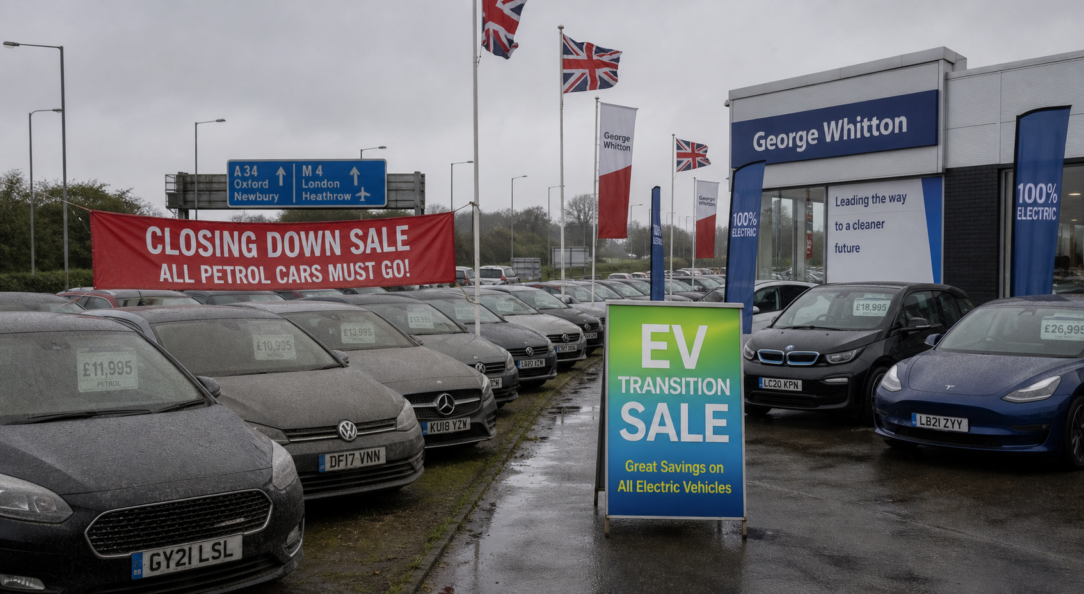
Why Petrol Car Sales Are Falling in the UK in 2026 (And What Drivers Are Choosing Instead)
 By in
By in
Petrol cars have been the backbone of UK motoring for decades. In 2026, however, their share of new car sales is clearly contracting. At the same time, electrified alternatives — battery electric vehicles (EVs), hybrids and plug-in hybrids — are gaining ground. This shift is not surprising in the abstract, but the reasons behind it are often misunderstood.
This article explains the factors behind the decline in petrol car sales, what that means for British drivers today, and how alternative powertrains are reshaping purchase decisions in real-world terms.
What the 2026 Sales Figures Show
Data from the shows that while petrol cars remain widely available, their share of new registrations has declined relative to electrified models. EVs alone now account for more than a quarter of new car registrations in some months of 2026, and hybrids together make up a substantial additional share. Traditional petrol cars, by contrast, make up a declining slice of the market.
This trend reflects both supply and demand factors. Manufacturers are bringing fewer petrol-only models to showrooms. Buyers are increasingly considering alternatives that offer lower running costs or better alignment with future regulations.
Policy and Regulation Are Reshaping the Market
One of the clearest reasons for the decline of petrol sales is government policy — especially the UK’s Zero Emission Vehicle (ZEV) mandate. Under this framework, manufacturers must sell a minimum proportion of zero-emission cars each year or face financial penalties. As the required percentage increases annually, carmakers prioritise placing EVs and highly electrified models into the UK market.
At the same time, the broader regulatory environment — such as the planned 2035 ban on sales of new petrol and diesel cars — affects buyer psychology. A petrol car purchased today may still be on the road after 2035, but the expectation of tightening emissions rules and potential urban restrictions influences choices at the point of purchase.
Regulations aimed at improving air quality, such as Clean Air Zones (CAZ) or Ultra Low Emission Zones (ULEZ) in major cities, also favour lower-emission vehicles. Petrol cars subject to daily charges in these zones can feel less appealing to urban drivers compared with hybrids or EVs.
Running Costs and Total Cost of Ownership
Fuel prices in the UK have been volatile in recent years. Electricity used for home charging is typically cheaper per mile than petrol, and the simple mechanics of an electric motor mean lower routine maintenance costs. This combination can make the overall cost of ownership for EVs and hybrids more attractive, especially for drivers who do most of their charging at home.
For drivers without home charging, public rapid charging can be more expensive per mile than petrol, but improvements in charging network density and pricing transparency are gradually narrowing this gap.
Hybrid Vehicles as a Transition Option
Many consumers are not ready for a full electric vehicle, particularly if they do a lot of motorway driving or lack convenient access to charging infrastructure. Hybrid vehicles — both self-charging and plug-in hybrids — have emerged as a transitional category that offers reduced fuel use while preserving internal combustion for longer trips.
For many buyers, hybrids represent a practical compromise: better fuel economy than petrol alone, with familiar refuelling behaviour and lower emissions. As a result, hybrids are contributing to the decline in pure petrol car sales even when drivers are not choosing full EVs.
Model Availability and Manufacturer Strategy
Automakers are adjusting their lineups in response to both regulation and consumer demand. Some popular petrol-only models have been discontinued or receive fewer updates, while electrified variants receive more marketing support. As resources shift toward EV and hybrid development, petrol engines are gradually deprioritised in future product planning.
Interestingly, this shift does not happen uniformly across all segments. In some performance or specialist vehicle categories, petrol engines still play a role because of customer preference or technical requirements. However, even in those niches, electrification is increasingly part of long-term strategy.
Used Car Market Dynamics
The used car market also influences new purchase decisions. A large and growing supply of nearly new petrol cars can temper demand for new petrol vehicles, but it also provides affordable alternatives for buyers not ready to switch away from combustion engines. Meanwhile, as more used EVs enter the market, price and accessibility improve for electrified options — reinforcing the broader shift.
Residual values for petrol cars remain robust in many cases, particularly in regions where charging access is limited. However, resale values are subject to evolving perceptions about future demand and regulatory landscapes.
Regional Variations Matter
The shift away from petrol is not uniform across the UK. Urban areas with dense charging networks and clean-air policies see higher adoption of electrified vehicles. Rural areas or regions with limited home charging infrastructure still have strong petrol preferences. These differences reflect practical considerations rather than ideological ones.
For example, a driver with overnight charging at home and short daily mileage may find an EV economically compelling. In contrast, a driver without home charging and frequent long intercity trips may prefer a hybrid or petrol vehicle until EV infrastructure becomes more mature in their area.
What This Means for Drivers Today
For British motorists thinking about their next car purchase, the decline in petrol sales does not mean an immediate need to avoid petrol altogether. It does, however, signal a market in transition. Key considerations for buyers include:
- Usage pattern: Daily commute, motorway driving, and trip frequency all affect whether petrol, hybrid or electric powertrains are appropriate.
- Charging access: Home or workplace charging can make EV ownership significantly more convenient and cost-effective.
- Ownership period: Cars kept for a long period may be more affected by regulatory changes than cars owned for only a few years.
- Total cost of ownership: Running costs, maintenance, insurance and fuel or electricity pricing should all factor into decisions, rather than just sticker price.
For many drivers, petrol will remain a reasonable choice in 2026 and beyond. However, for a growing portion of the market — especially urban drivers and fleet customers — electrified alternatives are increasingly practical both financially and operationally.
Common Misconceptions About the Decline of Petrol
“Petrol Cars Are Being Forced Off the Road Immediately”
This is not the case. Regulations such as the 2035 end of new petrol sales apply to new vehicles only. Existing petrol cars can continue to be sold in the used market and driven for many years thereafter.
“Electric Cars Are Always Cheaper to Own”
Ownership costs depend on individual factors such as charging access, mileage, electricity pricing and residual value. Some scenarios favour electric vehicles, others favour petrol or hybrid options.
“Hybrid Cars Are Just Petrol Cars with a Battery”
Hybrid powertrains offer meaningful fuel savings in many real-world conditions, particularly in urban or mixed driving. They are not equivalent to pure petrol cars in fuel consumption or emissions performance.
How This Trend May Evolve Beyond 2026
Looking beyond the current moment, several influences will continue to shape the role of petrol cars in the UK market. These include:
- Further tightening of the ZEV mandate and related regulations
- Ongoing improvements in charging infrastructure
- Pricing dynamics as EV and battery costs continue to evolve
- Consumer familiarity and confidence with electrified vehicles
These factors will not eliminate petrol cars overnight, but they will likely accelerate the shift toward a more diverse mix of powertrains over the coming decade.
For most drivers in 2026, the practical question is not whether petrol is “dead,” but whether it still makes sense for their specific driving needs. For many motorists, petrol remains viable. For others, hybrid and electric options now offer tangible benefits that make them worth serious consideration.